Cheap, Haiku/BeOS-compatible Hardware
Stephen B. - October 28th, 2008

|
|||||||||||||||
 |
|||||||||||||||
|
Over on the Haiku-OS.org blogs, Michael Crawford has made a very interesting post about an organization in San Jose, California, which recycles computer hardware that is “obsolete,” but is still usable. The head of the organization also happens to be one of Michael’s housemates – so he came up with a proposal to catalogue the hardware online and offer it to Open Source developers. From the post:
Sounds like a great deal, especially for Haiku developers – given that much BeOS / Haiku-compatible hardware is no longer available new, and many “obsolete” PCs are more-than capable of running small, efficient OSes like Haiku (I suspect a 1Ghz CPU is already overkill for most tasks). As a personal aside, another source that I’ve found very useful for buying used-but-still-capable hardware (much of which is BeOS-compatible) is VFXweb.com. They’re a small company in western Canada who buy up old computer hardware, do some cleaning and testing, re-sell it. The prices are a bit higher than what you can often find on eBay, but I’ve found it much less hit-or-miss than dealing with random eBay sellers (I haven’t had a single dud yet from them).
Recently we received an EMail from Pier Luigi Fiorini, one of the admins of OSDrawer, letting us know that the site’s new version is now online. From the announcement:
In other OSDrawer-related news, Pier recently sent an EMail to the Haiku Dev. mailing list announcing that development of the im_kit has restarted and the source is now hosted in the OSDrawer SVN respository (also mentioned on Slaad’s blog). And according to the project info page, a new release is due in 3 days (Nov. 1st). Looks like it’s time to update our “Download & Build im_kit” how-to.
Thanks to “scottmc” over on BeGroovy for spotting this page on the Haiku website: R1/Alpha1Proposals. Various proposals were recently submitted and voted on, in an effort to determine the requirements that Haiku will need to meet (and bugs that will need to be fixed) before it will be considered ready for an Alpha release. Some of the more interesting proposals that have been accepted: – Release as the GCC 2/4 hybrid – meaning that “applications compiled with GCC 2 and 4 can run out of the box” While this doesn’t necessarily mean that R1 – or even Alpha 1 – is right around the corner, it is still extremely encouraging that the Haiku developers feel they are close enough to create a roadmap.
The big story in recent BeOS-related news was the addition of swap file support to Haiku (spotted on ICO, also picked up by OSNews). This is especially good news for developers, as development-related tasks often gobble up large amounts of memory (compiling for one) – and without a swap file/partition, most (all?) OSes will hard-crash if they completely run out of memory. So while Haiku has been self-hosting for a while now, this should make the process of actually compiling Haiku from inside Haiku less dependent on physical memory (especially handy with virtual machines, which tend to be memory-constrained).
Small update. TiltOS informed us that its package manager (which is working on Haiku) has added support for new packages: antiword, bc, desktop-file-utils, fastjar, flac, gperf, joe, lame, libmng, pwgen, shared-mime-info, ode, uriparser, wget, vim, vorbis-tools, xreces_c Also the following packages where updated or fixed: automake, bzip2, curl, file. Nice day to you all !
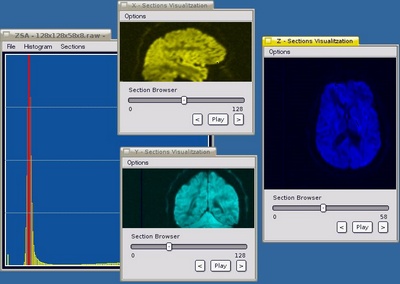
A (serious) but funny piece of software as been posted by VyR Software on BeBits: ZSA (as in Zeta for Scientific Application). This application was started as a small university project and the first version of the software came out in 2006. But, you will ask, what is this application all about ? It seems the app’ “allows you to evaluate the results of a scanned body by MR and Voxel handling”. My comprehension is that it can handle and preview information as found in all kind of huge amount of 3D data models (like in a 3D scanner of some brain… :-)
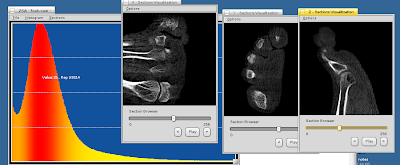
Or your feets !
Today ZSA has become a R5 compatible application ready to be used as well in Haiku. The new version includes also some minor fixes and feature. More information on the software as well as on the philosophy behind VyR Software can be found at their place: http://vyrsoftware.blogspot.com/
|
|||||||||||||||
|
|
|||||||||||||||