GSoC Interview: Ankur Sethi
Stephen B. - May 13th, 2009

|
|||||||||||||||||
 |
|||||||||||||||||
|
Today we bring you the second GSoC Interview, following on the heels of the Adrien Destugues interview last posted week. Today’s interview is with Ankur Sethi, an IT student from New Delhi who had submitted an application to add full text search and indexing functionality to Haiku. Unfortunately, due to limited resources (and a limit on the overall number of students accepted to GSoC this year), the Haiku project was not able to accept most of the applications they received – including Ankur’s. Read on for the interview.
As mentioned back on Friday, the various BeOS/Haiku news sites have gotten together to conduct interviews of the students who applied to Haiku for this year’s Google Summer of Code. The first BeOSNews entry is an interview with Adrien Destugues, who was accepted to work on internationalization support (under mentor Oliver Tappe). Read on for the rest of the interview.
On the various BeOS/Haiku news sites, interviews with applicants to Haiku for the 2009 Summer of Code have started popping up over the last few days. The interviews were conducted with both the students whose proposals were and weren’t accepted – credit for the idea goes to Matt Madia and the interviews are the result of a collaboration between several of the BeOS/Haiku news sites. So far, IsComputerOn has posted their interview with Maxime Simon, HaikuWare has posted their interview with JiSheng Zhang , and BeGroovy has posted their interviews with Smita Vijayakumar and Henri Vettenranta. Haiku Gazette has also posted an interview, in German, with Johannes Wischert. BeOSNews was not left out – the first of our interviews will be posted tomorrow. This also gives me the opportunity to point out that the listed of accepted students for the 2009 GSoC has been announced & posted on the Haiku website.
Over on HaikuWare, Karl has posted about the remaining work needed before an Alpha release of Haiku can be made. The details come from a report written by Lorglas (in German) after the most recent Begeistert. While the remaining tasks aren’t trivial, the list itself is encouragingly-short: the ATA bus manager needs a rewrite, and there is still some work needed before a bootable Haiku install CD can be created. Here’s hoping that, at this time next year, we’ll be talking about a Haiku Beta – or even a stable 1.0 release.
Sikosis and TheNerd have returned, bringing us the first Haiku Podcast of 2009 (direct link to the MP3). Sadly, the interview they had planned did not happen due to technical issues – so, instead, they provided a nice summary of Haiku-related news happenings since the last podcast. They also discuss the state of productivity software on Haiku and BeOS – or more specifically, the lack of modern / supported productivity apps. And, to finish off, they name Paladin – DarkWyrm’s new IDE – as their “BeBits App of the Month.”
HaikuWare recently broke the news that Gnash, a free/open source Flash player, has been successfully ported to Haiku. The work was done by coder Adrian Panasiuk, who has provided a screenshot of a youTube video being played with Gnash on Haiku – his webpage for the port also has a screenshot of the prefs panel. The port is at a fairly preliminary stage so far and has some specific requirements (a hybrid build of Haiku and Firefox built with GCC4), but it’s still great to see that some serious progress is being made.
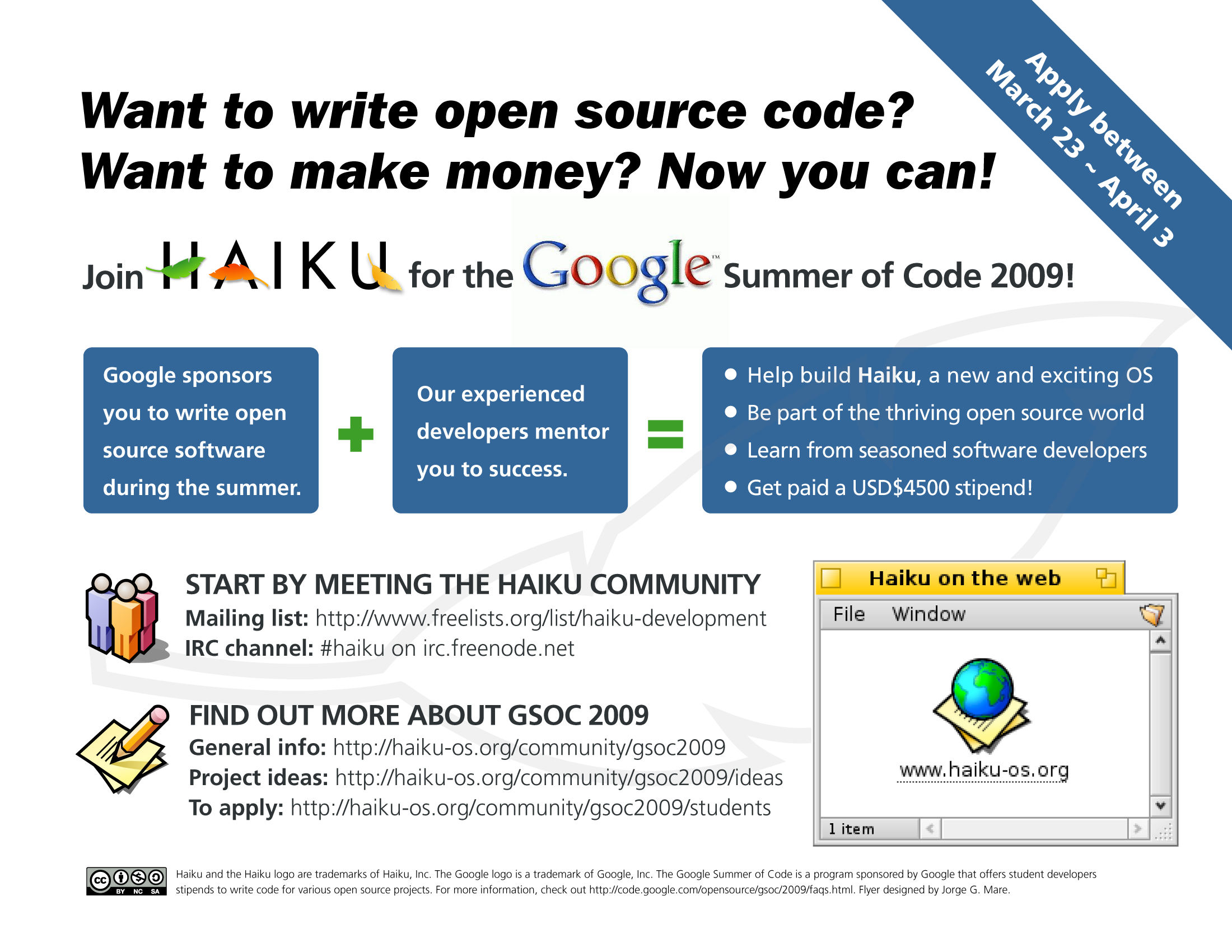
For the third consecutive year, Haiku has been accepted as a Google Summer of Code project. The news was announced on the Haiku site back on March 18th, it was also reported by IsComputerOn. An extensive list of possible tasks for students has been published, covering nearly every area of the Haiku OS – from updating ports of open source software, to low-level kernel development. There are also a instructions available for any students who would like to apply. Jorge G. Mare (Koki) has created an attractive flier to promote Haiku’s inclusion in this year’s GSoC (PDF and hi-res PNG). So even those of us who aren’t programmers can still help out by printing and posting copies of the flier in the local university’s computer science department.
|
|||||||||||||||||
|
|
|||||||||||||||||